Mapping SharePoint Content
You can map one or more Sites, Webs and Lists from your source tenant to your target tenant with this wizard when you think it is necessary to change URLs in the target tenant. This wizard uses a CSV file to specify the mapping. The template for this file is available from the wizard.
The target site and parent structure must exist on the target tenant for mapping webs and lists.
Webs cannot be mapped from a root web to a child web (demotion) or from a child web to a root web (promotion) using a map from file task. See Mapping Webs for advanced features like promotions or demotions.
|

|
NOTE: If your sites are geo-enabled, we recommend that you run the Map Geo Location task before you run this task. This task sets the geo locations using the default settings, and once the target location is set it can't be reset by the Map Geo Location task.
Workaround: Delete site from the SharePoint Contents list and rerun the Discover Site Collections task. |
Starting the Map SharePoint Content From File Task
- Sign in to Quest On Demand and choose an organization if you have set up multiple organizations.
- From the navigation pane, click Migrate > Projects to open the My Projects list.
- Create a new project or open an existing project.
- From the SharePoint tile on the project dashboard click Open. Then select the SharePoint contents tab.
- Click More > Map from File from the List View menu. The New Map From File Task wizard starts.
- Mapping File
- Task Name - name of the task. You can specify a custom name. The default name is Map SharePoint Content From File.
- Click Download Example File to download the CSV template. Two CSV template files are available in the ZIP file.
- Option 1: Prepare the map_from _file_example.csv file if your source tenant is not MultiGeo enabled, with the CSV format described below:
- Type - the SharePoint object being mapped: Site, Web or List
- SourceUrl - relative URL of the source object. For example /sites/SourceSite1
- TargetUrl - relative URL of the target object. For example /sites/TargetSite1
- TargetName - (optional) new display name of the target Site or Web if you want to change the display name of the object. If you don't specify a display name, the original display name from the source tenant will be used. You cannot rename a List because this property is ignored for lists.
|
|
NOTE:
- URLs in a mapping file are case sensitive and must be relative URLs.
- Sites cannot be merged or reorganized with a mapping file.
- Site templates cannot be changed with a CSV file.
- If the target site name is set in the CSV file, then this mapped name is used for the target site instead of migrating the site name from the source.
- CSV file names with non-ASCII characters are not supported. Maximum size is 15 MB.
|
Example 1 - The Target URL is used to rename a site from the source tenant.

Example 2 - The target URL is used to relocate the root site.
The root URL is relocated to a managed site in the target tenant called /sites/oldroot.

or
Option 2: Prepare the map_from _file_source_multigeo-example.csv if your source is a MultiGeo tenant.
|
|
NOTE: If the target is MultiGeo tenant, Map Geo Locations task must be run to map the target site before using the New Map From File Task wizard to map the site and content. |
- Type
- SourceLocation - geo location of the source SharePoint object
- SourceUrl
- TargetUrl
- TargetName
- Click Browse and upload the CSV file. The name of the uploaded file will appear.
- Click Next.
- Schedule
- Choose from one of three options to schedule the task. The scheduler will be activated after you complete the task wizard.
- Run now - task runs immediately.
- Run later - task must be started manually.
- Schedule - task starts at a future date and time entered in the corresponding calendar field.
- Priority - select a priority from the dropdown for the objects scheduled for migration with this task . Values are: Highest, High, Medium, Low and Lowest. The default priority is Medium. If the system is busy, the objects are queued. When the system accepts new work, objects are taken from the queue based on the assigned priority and age in the queue.
- Click Next.
- Summary
- Verify the task specifications as described below:
- Task Name - name of the task.
- Source tenant - name of the tenant in this project.
- Target tenant - name of the target tenant in this project.
- Scheduled start - date and time when the task will start. Now indicates that the task will start immediately.
- Click Back to revise or review a previous step or click Finish to complete the task wizard and start the task as scheduled.
- You can track the progress in the Tasks tab, monitor alerts and notifications in the Events tab and view the summary on the Dashboard.
- After the task is complete, the SharePoint Contents list is updated. Compare the Source Urlcolumn with the Target Url column for the specified sites, webs and lists. The Provision state of the mapped objects is set to Mapped.
Mapping Geo Located Term Stores
If you want to migrate SharePoint Term Stores to a geo located target tenant, you must map the discovered source term stores to active geo locations in the target tenant using a CSV file. The New Map Geo Locations Term Store Task wizard maps the geo locations of migrated SharePoint Term Stores based on the mappings in the CSV file described in the previous section.
- Sign in to Quest On Demand and choose an organization if you have set up multiple organizations.
- From the navigation pane, click Migrate > Projects to open the My Projects list.
- Create a new project or open an existing project.
- From the project Dashboard click Open in the SharePoint tile.
- Click the Term Store tab. Then click More > Map Geo Locations. The New Map Geo Locations Term Store Task wizard starts. Each step is described below:
- Mapping File
- Click Download Example File to download the template. Prepare and save the CSV file with your geo location mappings.

- Source Location - geo location of the source term store. Do not include Source Location column header if your source tenant is not geo enabled.
- Target location - geo location of the target term store. The geo location could be blank if you choose to use the Default target geo location in the SharePoint project settings.
|
|
NOTE: CSV file names with non-ASCII characters are not supported. |
- Click Browse and select the CSV file with the geo location mappings that you prepared.
- Click Open in the File Explorer window to load the file into the wizard
- Click Next.
- Schedule
- Choose from one of three options to schedule the task. The scheduler will be activated only after you complete the task wizard.
- Run now - task runs immediately.
- Run later - task must be started manually.
- Schedule - task starts at a future date and time entered in the corresponding calendar field.
- Click Next.
- Summary
- Verify the task specifications as described below:
- Name - name of the task. You can specify a custom name. The default name is Map Geo Locations From Term Store Task.
- Source tenant - name of the source tenant in this project.
- Target tenant - name of the target tenant in this project.
- Scheduled start - date and time when the task will start. Now indicates that the task will start immediately.
- Click Back to revise or review a previous step or click Finish to complete the task wizard and start the task as scheduled.
Mapping Sites
By default, the OnDemand Migration for SharePoint service will migrate a site using the same relative url and name as the source site. This step is particularly helpful when the source and target sites have different names or are located at different places. You can also change the template of sites with unsupported templates.
A site cannot be mapped if it was previously migrated in the same project. See the Considerations topic for details about migration behavior if the target site or sub-site that is mapped, already exists before the migration is started.
Starting the Map SharePoint Site Task
To change the name of a specific migrated site, relocate the site with a different Url or change an unsupported template during migration, follow the steps described below.
- Sign in to Quest On Demand and choose an organization if you have set up multiple organizations.
- From the navigation pane, click Migrate > Projects to open the My Projects list.
- Create a new project or open an existing project.
- Click the SharePoint tile, or click Open from the SharePoint tile to open the SharePoint Migration Workspace.
- Go to the SharePoint Contents tab.
- Select a specific site and then click Map Site from the site detail pane.
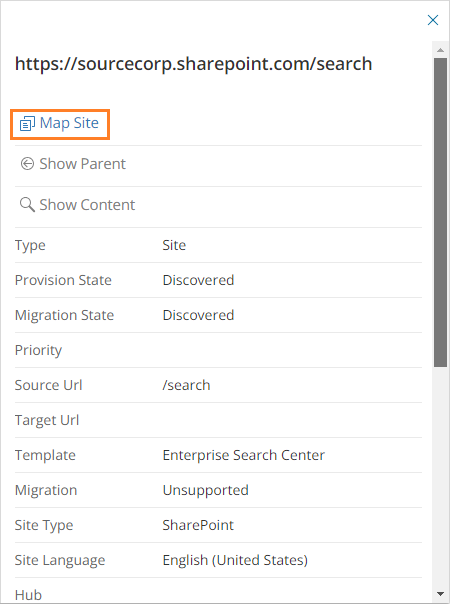
- The New Site Mapping Task wizard starts. Each step is described below:
- Map Settings

- Task Name - name of the task. You can specify a custom name. The default name is Map SharePoint Site.
- New Target Site Name - specify the new name of the target site (root website) if necessary, or retain the original name.
- New Target Url - specify the relative url in the target tenant or retain the original value. specify a different relative url in the target tenant to relocate the site if necessary.
- New Target Site Template - this option is available if the selected site has an unsupported template. Choose a supported template. The options are: Communication and Teams site (no Microsoft 365 group)
|
|
NOTE:
To find sites with unsupported site templates, clear the filters in the search ribbon. Then set the following filters: Migration = Unsupported and Type = Sites
Template mapping is only available for unsupported templates. When you use a supported template, the original site features may not be provisioned. However, supported lists and list items can now be migrated to the target tenant.
Limitation: Sites with the "TeamsChanne#0" or "TeamsChanne#1" template cannot be mapped to a different template. These TeamsChannel based sites are provisioned with the ODM Teams provisioning task. |

- Promote child webs to sites - select this option to promote all first level child webs in this site to a new site. Promoted site name and url will be based on the current name of the promoted child web. This option is available for supported site templates only. Sites with unsupported templates cannot be promoted.
- Skip Child Webs - select this option to exclude child webs when migrating this web.
- Click Next.
- Summary
- Verify the task specifications as described below:
- Name - name of the task.
- New Target Site Name - new name of the target site (root website)
- New Target Url - the relative url in the target tenant.
- New Target Site Template - option to match sub-sites and other descendant structures.
- Promote all child webs to sites - indicates whether child webs will be promoted to sites.
- Click Back to revise or review a previous step or click Finish to complete the task wizard and start the task as scheduled.
- You can track the progress in the Tasks tab, monitor alerts and notifications in the Events tab and view the summary on the Dashboard.
- After the task is complete, the SharePoint Contents list is updated. Compare the Source Urlcolumn with the Target Url column for the selected site. The Provision state of the selected site is set to Mapped.
Mapping Geo Located Sites
|
|
NOTE:
This feature is available if the target tenant is geo-enabled.
We recommend that you run the Map Geo Location task before you run the Mapping from File task. The Mapping from File task sets the geo locations using the default settings, and once the target location is set it can't be reset by the Map Geo Location task.
Workaround: Delete site from the SharePoint Contents list and rerun the Discover Site Collections task. |
If you want to migrate SharePoint sites to a geo located target tenant, you must map the discovered source tenant sites to active geo locations in the target tenant using a CSV file. This is a two-step process:
Step 1: Prepare the CSV file
|
|
NOTE:
- You can download a CSV template when you start the New Map Geo Location Task wizard and click Download Example File from the Mapping File step.
- CSV file names with non-ASCII characters are not supported.
|
To prepare a CSV file with geo mapped SharePoint sites, use the CSV format described below:

- Source URL - column header for the URLs of the site in the source tenant
- Source Location - column header for the geo-location of the site in the source tenant.
- Target Location - column header for the geo location of the site in the target tenant. The geo location could be blank if you choose to use the Default target geo location in the SharePoint project settings.
Step 2: Start the Map Geo Location Task
The New Map Geo Location Task wizard maps the geo locations of migrated SharePoint sites based on the mappings in the CSV file described in the previous section.
- Sign in to Quest On Demand and choose an organization if you have set up multiple organizations.
- From the navigation pane, click Migrate > Projects to open the My Projects list.
- Create a new project or open an existing project.
- From the project Dashboard click Open in the SharePoint tile.
- Click the SharePoint Contents tab. Then click More > Map Geo Location from File. The New Map Geo Locations Task wizard starts. Each step is described below:

- Mapping File
- Task Name - name of the task. You can specify a custom name. The default name is Map Geo Locations From File.
- Click Browse and select the CSV file with the geo location mappings that you prepared.
- Click Open in the File Explorer window to load the file into the wizard
- Click Next.
- Schedule
- Choose from one of three options to schedule the task. The scheduler will be activated only after you complete the task wizard.
- Run now - task runs immediately.
- Run later - task must be started manually.
- Schedule - task starts at a future date and time entered in the corresponding calendar field.
- Click Next.
- Summary
- Verify the task specifications as described below:
- Task Name - name of the task.
- Source tenant - name of the source tenant in this project.
- Target tenant - name of the target tenant in this project.
- Scheduled start - date and time when the task will start. Now indicates that the task will start immediately.
- Click Back to revise or review a previous step or click Finish to complete the task wizard and start the task as scheduled.