|
1 |
|
2 |
On the Source page, navigate to and select the template file you want to deploy. |

|
3 |
On the OVF Template Details page, review the template details. |
|
4 |
On the End User License Agreement page, review and accept the license terms to continue. |
|
5 |
On the Name and Location page, accept the default name (recommended for technical support purposes) or type your own. |
|
6 |
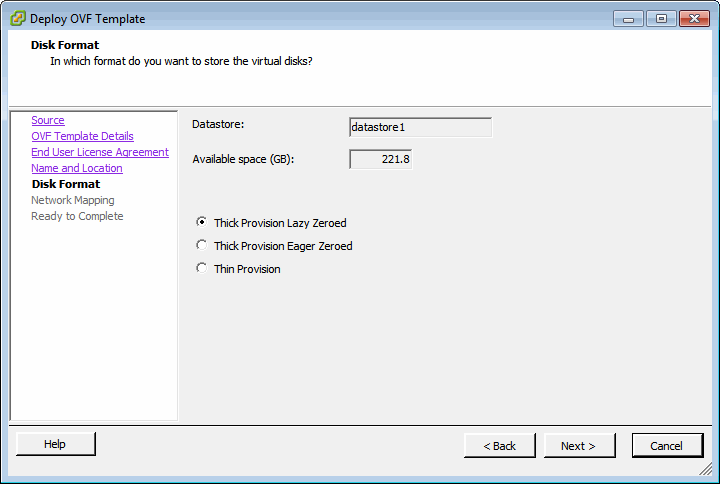
On the Disk Format page, if you have more than one datastore, select the datastore you want to use. For example, you may want to select the datasource with the highest amount of free space. Accept the default selection of Thick Provisioning, which reserves the required hard disk space immediately (as opposed to Thin Provisioning, which allocates disk space on demand). |
|
7 |
On the Network Mapping page, map Network 1 to the VM Network port group. If Network 2 is displayed, map it to the Capture Network port group. |

|
8 |

|
9 |
When you are done, click Finish. |
|
1 |
|
2 |

|
3 |
On the OVF Template Details page, review the template details. |
|
4 |
On the End User License Agreement page, review and accept the terms to continue. |
|
5 |
On the Name and Location page, accept the default name (recommended for technical support purposes) or type your own. |
|
6 |
On the Disk Format page, if you have more than one datastore, select the datastore you want to use. For example, you may want to select the datasource with the highest amount of free space. Accept the default selection of Thick Provisioning, which reserves the required hard disk space immediately (as opposed to Thin Provisioning, which allocates disk space on demand). |

|
7 |
On the Network Mapping page, create the following mappings: |
|
• |
Network 1 = VM Network (same as the deployed Management Server and Archiver) |
|
• |
Network 2 = Capture Network (same as the deployed Archiver) |
|
• |
Network 4 = Optional—Monitoring Network B |
|
IMPORTANT: If you do not map Network 4 to a monitoring switch, when you finish the wizard, you must disconnect Network 4 (as described in Step 10) to avoid picking up stray data. |

|
8 |

|
9 |
When you are done, click Finish. |
|
10 |
Important—If you did not change the default mapping for Network 4, disconnect it now. |
|
a |
|
b |
Select Network Adapter 4. |
|
c |
In the Device Status area, clear the Connect at power on check box. |
|
d |
Click OK. |
|
• |
Multiple hosts — Connect the Capture Network NICs on the hosts containing a Sniffer or an Archiver to a private network switch. |
|
• |
Two hosts — Connect the hosts’ Capture Network NICs with a network cable. |
|
• |
One host — No external connections required. |
|
• |
Centralized Sniffer (Network tap) — Connect the Monitoring Network A and Monitoring Network B NICs to the monitoring ports on the network tap. For instructions, see Connecting Sniffers to network taps. |
|
• |
Local Sniffers — No external connections required. |
|
• |
Monitored hosts — All monitored hosts should already have their VM Network NIC connected to the public network switch that connects to the intranet. |
|
• |
Foglight APM appliance hosts — If you have not already done so, connect the VM Network NIC on hosts dedicated to running Foglight APM appliances to the same public network switch as the monitored hosts. |
|
2 |
From the toolbar, click Open Console. |